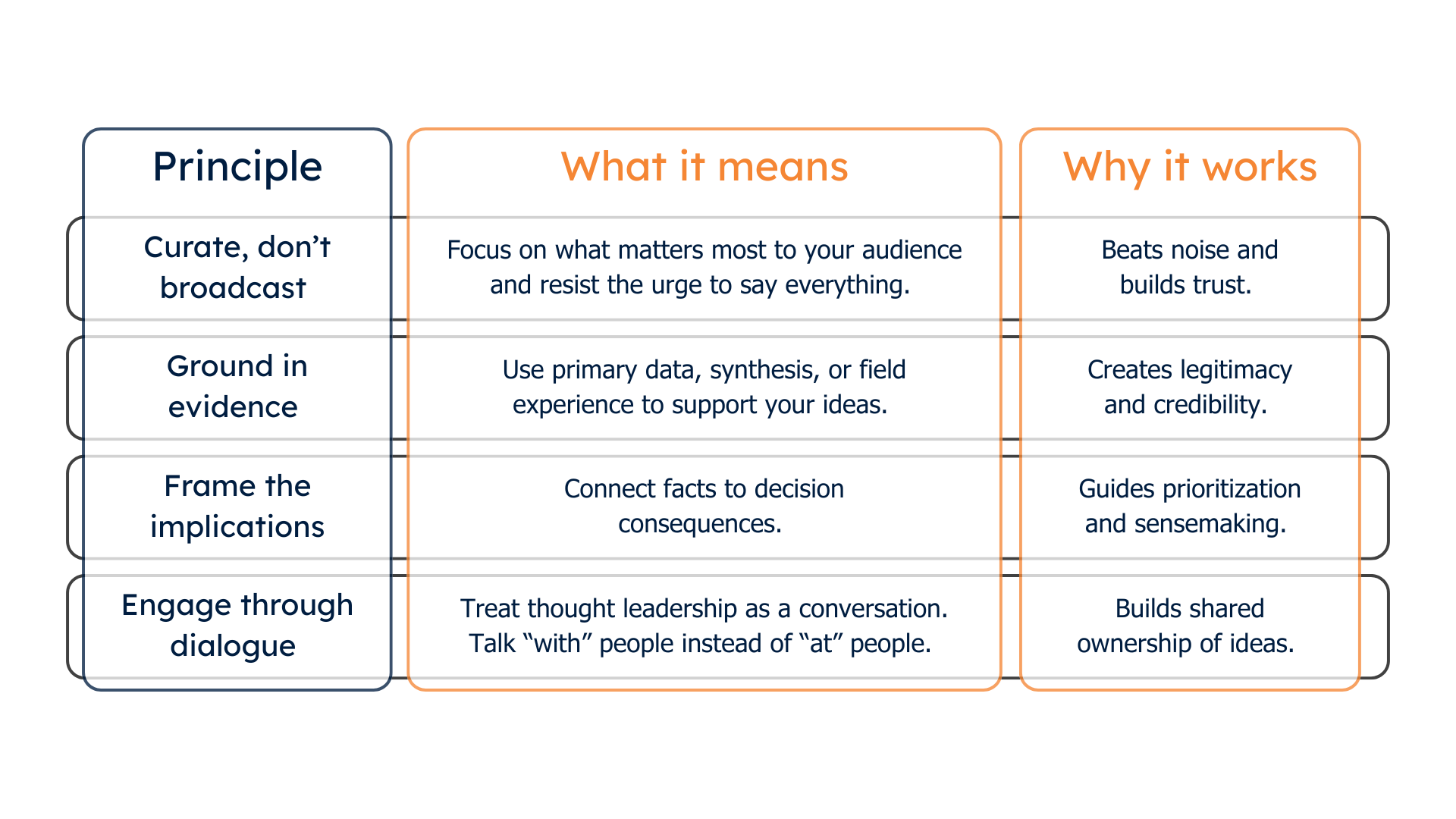
We’ve observed three consistent approaches that shape how people see the world. Used together, they’re a playbook for developing your own thought leadership strategy.
Great thought leadership defines the problem space. Instead of overwhelming your audience with data, look to simplify complexity without losing truth. One way to do this is by introducing new mental models or frameworks that help decision-makers interpret information in a fresh way.
A report published by PwC and written by the Economist Intelligence Unit found that executives value content that changes how they think more than they value content that adds more numbers into their daily lives. It’s not about providing more data; it’s about contributing to your audience’s ability to interpret that data into something meaningful.
Tip: Use stories, analogies, or visual frameworks to make complex ideas or data easier to grasp. Ask yourself: Can I provide personal examples or a lens that helps people see this problem differently?
Ideas gain traction when they show up in credible circles. When others in your industry start talking about the same concept, it signals legitimacy and makes people want to support a new idea, especially the “Early Majority” which is about 34% of people.
Tip: Share your insights in places where influencers and peers gather, such as industry events, LinkedIn discussions, or respected publications. Encourage discussion and conversations so your idea feels like part of a movement instead of a solo voice.
Insights that combine evidence with interpretation help leaders move from indecision to commitment. A Bain & Co study shows big decisions often fail not because the wrong choice was made, but because the team lacked alignment, clarity, and execution follow-through. Insights enable teams to move forward with confidence.
Tip: When you’re presenting data, pair it with a clear point of view. Don’t just present numbers. Explain what the information means and what action it suggests.
In other words, influence begins when insights reduce uncertainty.
At SP&G, we use the term “Executive Insight” to describe how organizations can move from providing relevant information to shaping influence. Our Executive Insights practice dives into the data and experiences in your market to provide tangible support for thought leadership. We provide tools like an Executive Priority Map or a Gap Map to help leaders focus their efforts, sharpen their insights, and communicate with clarity.